Dynjandi Waterfall: A Complete Guide to Isafjordur's Bridal-Veil Falls
The short answer
Dynjandi drops about 100 metres over stepped basalt, spreading as it falls, with six smaller waterfalls below it. It has been protected since 1981, there is no gate and no charge, and there is also no shop. The walk up takes about fifteen minutes over loose rock, and the stops on offer run from fifty minutes to an hour and fifty.
What Dynjandi actually is
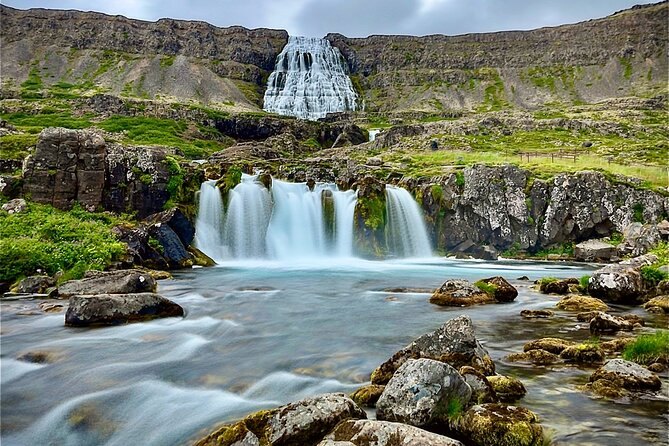
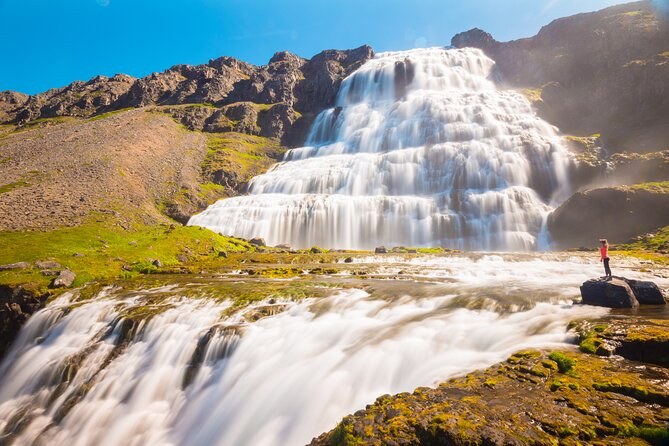
A fan. That is the thing photographs get wrong: Dynjandi does not fall in a column, it spreads as it drops, so it is narrow at the lip and wide at the base. The water comes about a hundred metres down stepped basalt at the head of Arnarfjörður, and the steps are what do it — each shelf throws the flow outwards a little further than the one above.
The name means "the thundering one". It has been a protected natural monument since 1981, and it is the largest waterfall in the Westfjords — the anchor of everything worth the drive from this town.
The six waterfalls below the one you came for
Most visitors photograph the big fan and miss the fact that the path up passes six more. The regional tourist board names them in order: Fjallfoss, Hundafoss, Strokkur, Göngumannafoss, Hrísvaðsfoss and Sjóarfoss. They are smaller, they are right beside the path, and several of them are better to stand next to than the main fall is, because you can get close.
The climb, honestly
About fifteen minutes from the car park to the foot of the main fall, over loose rock that gets slippery in the wet. It is a walk rather than a hike, but it is not flat and it is not paved. Travellers on four different coach trips say the same two things: wear shoes with grip, and you do not have to go all the way up.
That second point matters more than it sounds. The fan is in full view from the bottom. If you are travelling with someone who cannot manage the path, they lose the close-up and nothing else.
How long you need at the fall
| Time at the fall | What that buys | Which trips offer it |
|---|---|---|
| 50 minutes | The bottom, one or two of the lower falls, photographs | The private superjeep run |
| 1 hour | Most of the climb if you keep moving | The private days and the ATV trip |
| 1 hour 15 | The climb without hurrying | The four-hour photo-stop tour |
| 1 hour 30 | The climb, the top, and time at the lower falls | The cheapest coach, where it is written into the fare |
| 1 hour 50 | All of it, twice if you want | The farm tour |
One traveller with ninety minutes described making a family decision on the spot: reach the top and do not stop, go partway and catch your breath, or stay at the bottom and have time for the toilets before the coach leaves. That is a fair summary of what an hour and a half is.
Getting there, and what changed in 2020
Route 60 south from Ísafjörður, about an hour. Until October 2020 that road climbed Hrafnseyrarheiði, a mountain pass that closed for much of the winter. The Dýrafjarðargöng tunnel, 5.6 km, took the pass out of the route and cut about 27 km off the journey.
It did not take out the weather. Snow, ice and avalanche risk still close sections of Route 60, and Dynjandi is not a reliable year-round destination even now. Check road.is on the morning, and see the weather page for the pattern across the year.
What is there when you arrive, and what is not
- There is a marked car park, a path, and a small block of toilets.
- There is not a ticket office, a shop, a café or anywhere to buy water. One traveller noted the absence specifically, along with a long queue for the facilities.
- It costs nothing to park, to walk or to climb. The regional tourist board publishes no fee of any kind.
Driving yourself against taking a coach
With a hire car in summer this is straightforward and cheap: an hour each way, a marked car park, no fee at either end. If you are staying several nights, drive it — the visiting page covers hiring and the roads. The without a tour guide does the full arithmetic.
Off a ship, the calculation changes. A road closure or a puncture on Route 60 is your problem and the ship will not wait, whereas a coach operator's timetable is built around the all-aboard. That is what the fare buys, and at From $81 it is not much to pay for it.
What else is on that road
Þingeyri, on Dýrafjörður, which several trips use as a second stop and where the ATV rides run — things to do sorts those by how long you have.
Þingeyri is not the only stop on that road. Holtsbryggja pier, a fifteen-minute photo stop on the four-hour tour. And the farm at Gemlufall, where the farm-and-waterfall coaches break for coffee and a slice of hjónabandssæla, the oat and rhubarb cake whose name means happy-marriage cake. The highlights page sets each of them out.
Every Dynjandi waterfall tour from Isafjordur on offer stops at the same car park; what they differ on is how long they leave you there.
Every trip named here is compared on price, hours and what the fare covers at Isafjordur Tours.
Frequently asked questions
How tall is Dynjandi?
How much does it cost to visit Dynjandi?
How hard is the walk up to the waterfall?
How far is Dynjandi from the port?
Can you reach Dynjandi in winter?
Can I drive to Dynjandi myself?
Trips that give you the longest at the fall
Dynjandi Waterfall and Westfjords Farm Tour
The longest stop at the fall of any coach here, at an hour and fifty minutes, with a farm break on the way back.
From $154 per person
Check Availability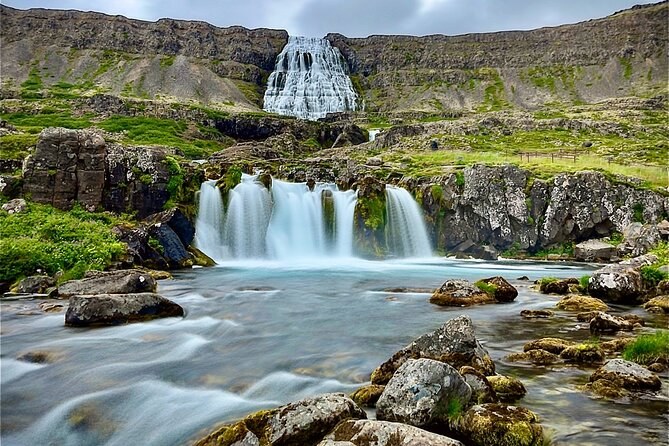
3.5-Hour Sightseeing Tour to Dynjandi Waterfall
The waterfall and the fjord road with nothing else attached, out of the harbour and back in three and a half hours.
From $82 per person
Check Availability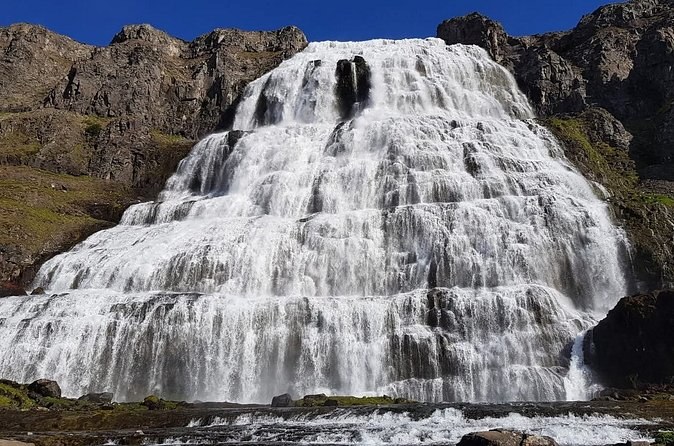
Private Superjeep Tour to Dynjandi Waterfall
A private superjeep for up to four, fifty minutes at the fall and half an hour at Þingeyri.
From $890 per group, up to 4
Check AvailabilityIf Dynjandi is the reason you are coming north, the only decision left is how long you want at the bottom of it — and that is the one thing these trips genuinely differ on.