How to Visit Isafjordur in 2026: Tours, Getting There and What to Know
The short answer
Fly from Reykjavík City in 40 minutes, drive 454 km in about six hours, or arrive by ship. Nothing here charges admission, including Dynjandi; what you pay for is the hour of road between the town and the waterfall. Allow three to four hours for any trip, dress for wind rather than temperature, and book something refundable.
Two arrivals that need completely different plans
Almost everyone who reaches Ísafjörður does it in one of two ways, and the advice for them barely overlaps. If you are off a cruise ship, you have a fixed number of hours, everything you might book starts within a kilometre of where you land, and your only real enemy is the all-aboard time. If you have driven or flown, you have days, a vehicle, and the freedom to go when the weather is right rather than when the itinerary says.
This guide covers both, in that order. Where they diverge, it says so.
Getting here: four routes and what each really costs you
| Route | Time | Season | The catch |
|---|---|---|---|
| Fly Reykjavík City (RKV) to Ísafjörður (IFJ), Icelandair | About 40 minutes | Year-round | Small aircraft; book early |
| Drive from Reykjavík | About 6 hours, roughly 454 km | Reliable in summer | Winter closures can add hours or stop you |
| Ferry Baldur, Stykkishólmur to Brjánslækur | Plus a long drive north | Year-round | It shortens the road, it does not replace it |
| Cruise ship | A call of roughly 6 to 10 hours | Roughly May to September | You do not choose the date or the length |
The drive is the one people underestimate. Route 1, the ring road, does not come to the Westfjords; this is a deliberate detour up a peninsula of long fjords, and the last stretch takes as long as it looks on the map and then some. In winter, the weather page explains what closes and when.
What the town itself is
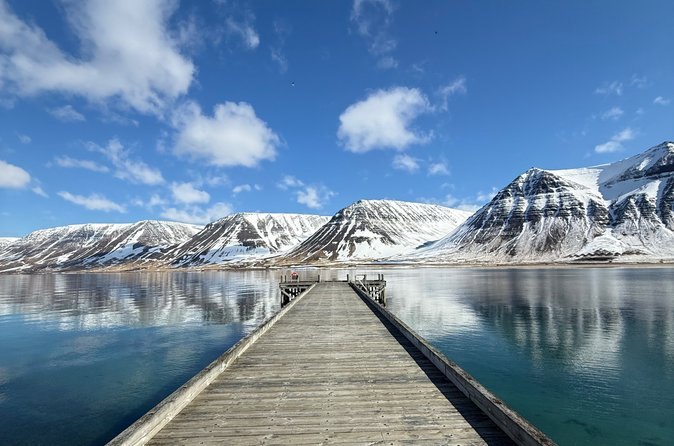
Ísafjörður is about 2,700 people on a sand spit in Skutulsfjörður, where that fjord meets the much larger Ísafjarðardjúp. It is the administrative centre of the Westfjords, which is the least populous region in Iceland. Mountains ring it on three sides, and they are high enough to matter: from about 24 November the sun does not clear them, and the town sees none until about 25 January.
You can walk it end to end in about twenty minutes. At the far end of the spit, Neðstikaupstaður holds the oldest cluster of timber-frame houses in the country — Krambúð of 1757, Faktorshús of 1765, Tjöruhúsið of 1781 and Turnhúsið of 1784. The last is the Westfjords Heritage Museum; the 1781 warehouse is a seafood restaurant. The highlights page covers what is inside each.
The thing you actually came for
Dynjandi. About a hundred metres of water spreading over stepped basalt at the head of Arnarfjörður, with six smaller falls below it, protected as a natural monument since 1981. It is roughly an hour's drive south of town on Route 60, through the Dýrafjarðargöng tunnel that opened in October 2020 and replaced the old pass over Hrafnseyrarheiði.
There is no gate, no ticket office and no charge. There is also no shop and no café, which catches people out. What you are paying a tour operator for is the road, and that is a fair trade if you have not got a car.
What a day here costs
| What | Price | Set by |
|---|---|---|
| Dynjandi, including the car park and the climb | Free | It is a protected monument |
| Walking the town and Neðstikaupstaður | Free | — |
| Westfjords Heritage Museum | ISK 1,600 adult · ISK 1,200 senior | The museum, 15 May – 15 Sep |
| Ósvör Maritime Museum, Bolungarvík | Charged; no figure published | The museum, 10 Jun – 20 Aug |
| A guided coach to the waterfall | From From $81 a head | The tour operators |
| A boat out onto the Djúp | From $111 a head | The tour operators |
| A private day for up to four | From $890 per group | The tour operators |
The pattern is worth naming, because it is unusual: the sights are free and the distance is not. That makes the arithmetic simple. With a hire car and a week, you pay for fuel. With a ship and six hours, you pay someone to remove the risk.
If you are off a ship
- Coaches wait outside the terminal. There is one exit, and the buses line up after customs. Travellers consistently describe the signage as clear.
- The boats are further round. The Vigur pier is about six minutes' walk; the whale-watching boathouse on Ásgeirsgata is a red building set back behind others and is the commonest thing people get wrong here.
- Three to three and a half hours is the standard shape. That is what almost every trip runs to, and it is built around a typical call.
- Book something refundable. Ísafjörður calls do get dropped for weather, and operators here have refunded in full when a tender could not run.
The cruise port page goes through the tender question, the walking distances and the all-aboard margins in detail.
If you have a car and several days
Different problem entirely: not what fits, but what to do with the weather you get. Keep Dynjandi for a clear morning and the museums for a wet afternoon. Take the tunnel to Bolungarvík for Ósvör and, between roughly mid-June and mid-September, the road up Bolafjall to the 638-metre platform that opened in 2022. Drive out along the Djúp to the Hvítanes seals. Save an evening for Súðavík.
What to wear, in any month
The warmest month here averages 9.9 °C. That number does most of the work: pack layers, a windproof shell, gloves and a hat, and treat July as you would treat a cold spring day at home. Shoes with grip matter more than waterproofs, because the path beside Dynjandi is loose rock, and the boats are boarded by steps.
Wind, not rain, is what changes plans here. It is what stops a sailing, and it is why an open deck feels several degrees colder than the forecast.
Getting it wrong, and how not to
- Assuming the waterfall is close. It is an hour each way. A "quick look" is a half-day.
- Turning up at the departure time. Check-in on the boats runs fifteen to thirty minutes before, and the coaches fill.
- Expecting to buy lunch at Dynjandi. There is nothing there.
- Booking August for puffins. They start leaving in the first week. Best time to visit lays out all four calendars.
If you would rather not assemble the day yourself, the Isafjordur day tours bundle the road, the driver and the timing into one fare.
Every trip named here is compared on price, hours and what the fare covers at Isafjordur Tours.
Frequently asked questions
How do I reach the Westfjords?
How much does it cost to visit Dynjandi?
Do I need a car?
How long do Isafjordur tours last?
What should I wear?
Can I cancel if my plans change?
Trips that fit a first visit
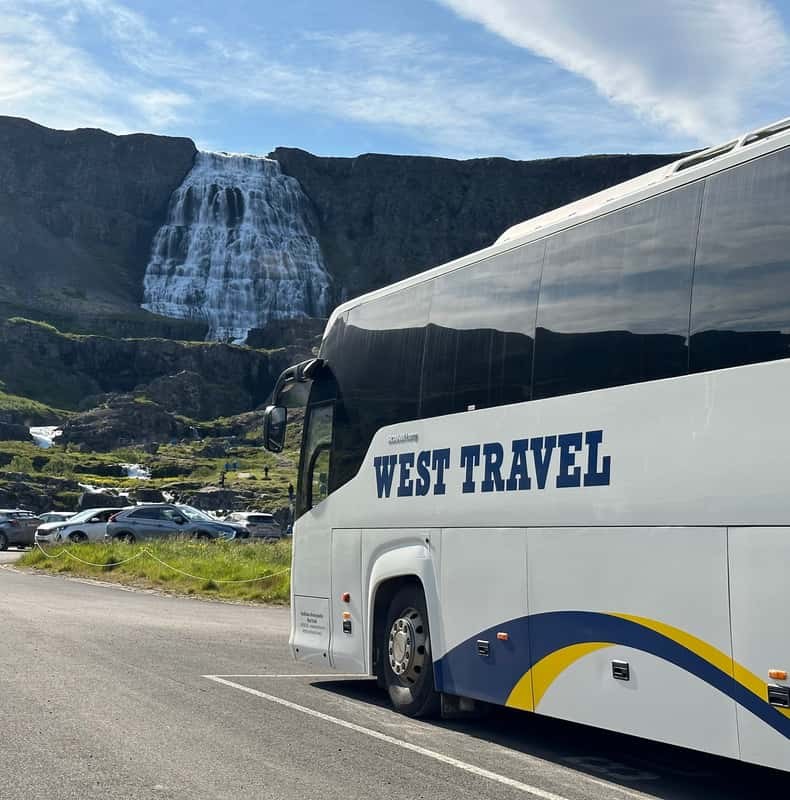
Dynjandi Waterfall Day Trip from Isafjordur
The cheapest way to stand under Dynjandi, and the shape almost every ship call is built around.
From $81 per person
Check Availability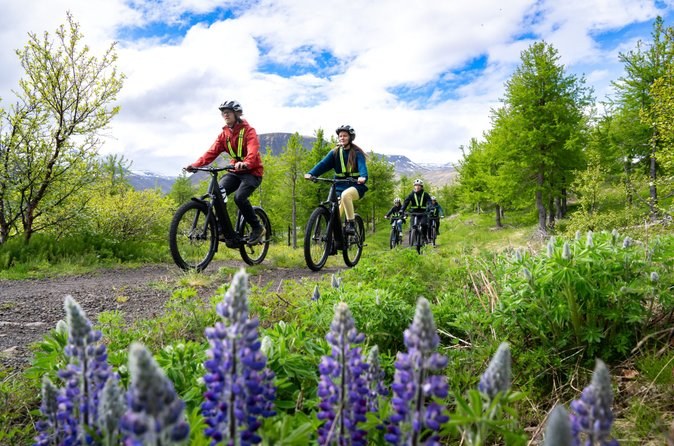
Guided E-Bike Tour in Isafjordur
Two hours on a pedal-assist bike round the town and the hills above it, capped at six.
From $169 per person
Check Availability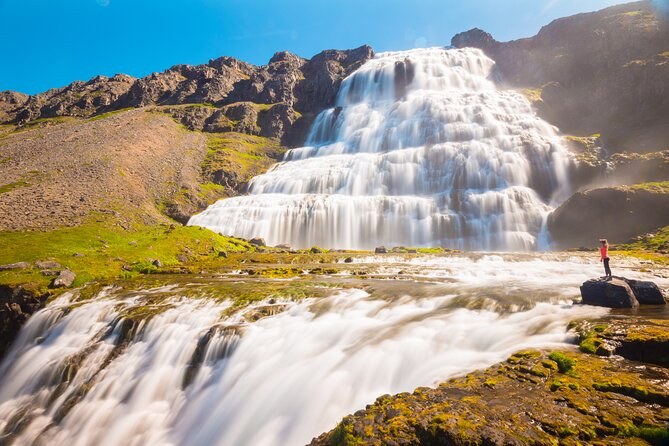
Dynjandi Waterfall and Westfjords Farm Tour
The longest stop at the waterfall of any coach here, with coffee and cake at a working farm on the way back.
From $154 per person
Check AvailabilityOnce you know which of the two arrivals you are, the rest of the planning is short: pick one thing per three hours, dress for the wind, and keep the refundable booking.